
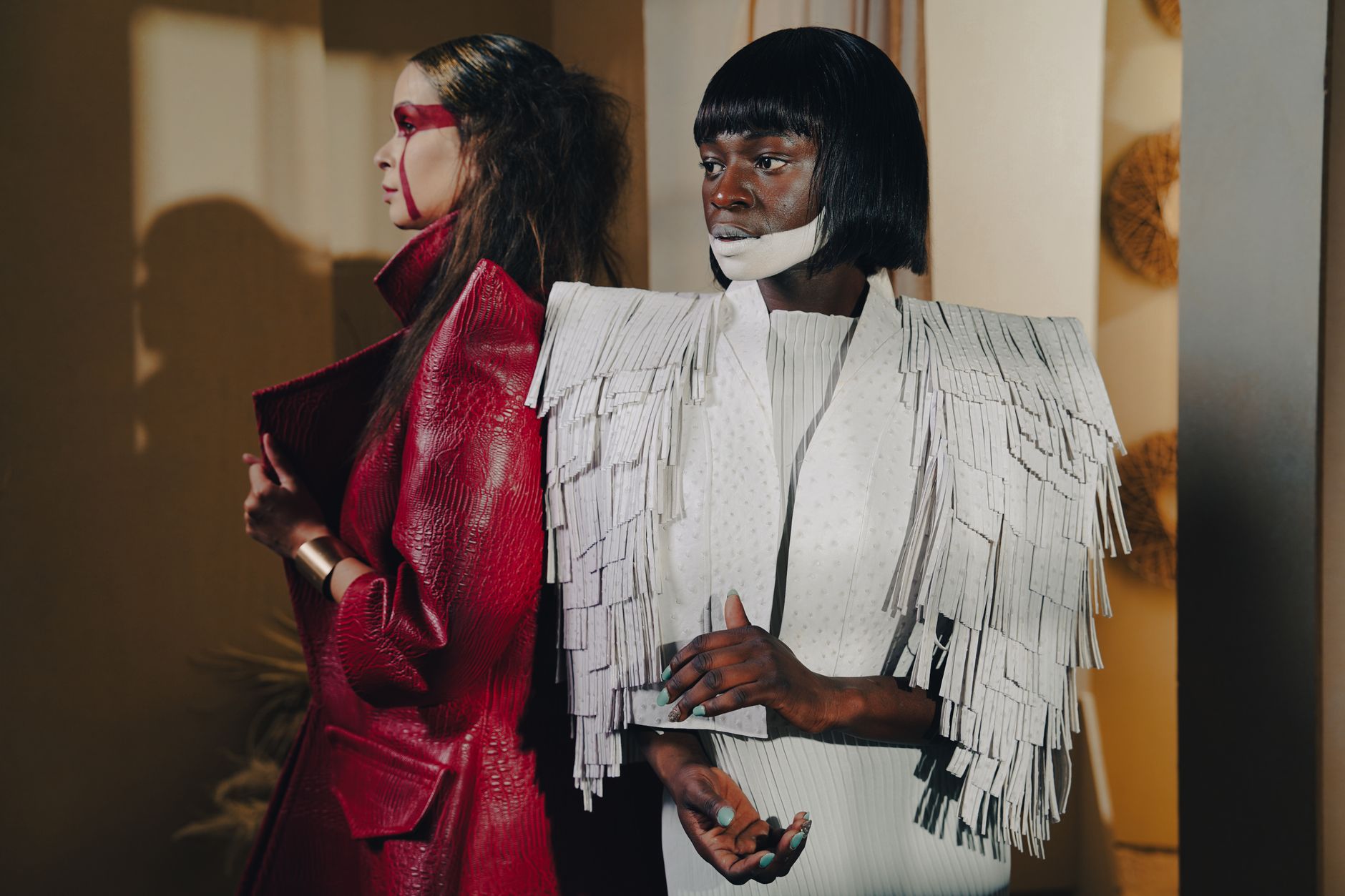
February in London means one thing beyond grey skies and overpriced flat whites: the city temporarily becomes the most exciting place on earth for fashion. London Fashion Week A/W 2026 delivered exactly what you’d expect from a city that has never once played it safe — confrontational silhouettes, a reckoning with sustainability that went far beyond token gestures, and a handful of designers who looked at the current cultural moment and decided to make it wearable. This wasn’t Paris doing elegant restraint. This wasn’t Milan doing luxury maximalism. This was London, doing London.
For anyone navigating the city’s endlessly shifting style landscape — whether you’re shopping on Brick Lane, browsing the rails at Dover Street Market, or simply trying to work out what to wear on a Tuesday in Peckham — what happens on the LFW schedule matters more than you might think. Trends don’t trickle down from the catwalk like they used to; they detonate across Instagram, filter into the independents on Carnaby Street within months, and reshape what Londoners are actually wearing on the Overground by the following autumn. So let’s break down what actually happened, what it means, and which looks are genuinely going to land in your world.
London Fashion Week A/W 2026 in Context: How Does It Stack Up?
London Fashion Week has been running since 1984, but 2026 marks a particularly interesting inflection point. The British Fashion Council reported a record 74 designers on the official schedule this season, with a notable shift toward emerging talent over established houses — a deliberate move that reflects both the financial pressures on mid-tier brands post-pandemic and a genuine appetite for new voices. International buyers from Seoul, Tokyo, and New York were back in force, and the venues — from the Tate Modern’s Turbine Hall to a converted industrial space in Bermondsey — felt more considered than they have in years.
Here’s how A/W 2026 compares to recent seasons at a glance:
| Season | Dominant Mood | Key Silhouette | Standout Moment |
|---|---|---|---|
| A/W 2024 | Post-pandemic release, maximalism | Volume everywhere, puffed sleeves | Simone Rocha’s floral armour |
| S/S 2025 | Quiet luxury meets London grit | Sleek tailoring, minimal ornamentation | Nensi Dojaka’s bodycon refinement |
| A/W 2025 | Nostalgia, Britishness, irony | Oversized coats, deconstructed suiting | Burberry’s countryside-punk collision |
| S/S 2026 | Urgency, protest, craft | Raw edges, unfinished hems | A.W. Akers’ recycled archive collection |
| A/W 2026 | Structured chaos, emotional dressing | Sharp shoulders, fluid skirts | Multiple designers referencing working-class London |
The through-line from the last two years is clear: London designers are increasingly interrogating what it means to dress in a city under economic and cultural pressure. That’s not to say everything was po-faced — there was humour, there was joy, there was one truly spectacular moment involving a designer sending a model down the runway in what appeared to be a repurposed London bus seat cover. But underneath all of it ran something genuine.
What’s Happening Right Now: The A/W 2026 Trends That Actually Matter
Forget the micro-trends that trend forecasters will package into listicles by March. These are the movements that felt substantial, recurring across multiple shows, and rooted in something culturally real.
The Big Shoulder Is Back — But It’s Angrier This Time
The power shoulder has been lurking for a couple of seasons. At A/W 2026, it arrived fully formed and with something to say. This isn’t the 1980s boardroom rehash that plagued high street rails in 2022. These shoulders are architectural — extended, sometimes asymmetrical, occasionally exaggerated to the point of absurdity — and they’re paired with everything from fluid bias-cut skirts to straight-leg trousers that break cleanly over the shoe. The silhouette reads simultaneously confrontational and elegant, which is very London, if you think about it.
Utility Wear Gets a Serious Upgrade
Cargo pockets, technical fabrics, workwear references — utility dressing has been building momentum for years, but at A/W 2026 it shed any remaining associations with either military surplus cosplay or the kind of anodyne functionality you’d find in a Uniqlo catalogue. Designers were referencing construction workers, market traders, mechanics — actual working Londoners — and doing it with proper craft. Waxed cotton, heavyweight canvas, reinforced stitching. Clothes that looked like they could genuinely withstand a winter in this city.
Texture Layering Replaces Pattern Mixing
If the dominant print of recent years was maximalist pattern clashing, A/W 2026 offered a more tactile obsession. Designers layered boucle over silk, velvet alongside raw linen, shearling against structured wool. The eye travels differently — not pulled between competing colours but drawn into the physical surface of the garment. It’s a quieter form of dressing, but no less considered.
Coats Are the Main Event
This is London, and it is autumn/winter, so this should surprise nobody — but the quality and ambition of outerwear at A/W 2026 was genuinely striking. We’re talking investment-piece territory: long, structured, often belted, in deep jewel tones (a particular obsession with burgundy, forest green, and a specific shade of petrol blue) or, conversely, a very deliberate return to classic camel and charcoal. The message was clear: one extraordinary coat, worn over anything.
The Full List of A/W 2026 Micro-Trends Worth Watching
- Burgundy as the season’s defining colour — appearing in velvet, leather, and heavyweight knit across at least a dozen shows
- Knee-high boots with architectural heels — not stilettos, not block heels, something altogether more structural
- Visible interior construction — lining deliberately shown, seams left raw, interfacing exposed as a design feature
- Gloves back as a serious accessory — long opera gloves, short leather driving gloves, even knitted gauntlets
- The return of the brooch — not your grandmother’s cameo, but large-scale, sculptural, statement brooches worn on lapels and scarves
- Dark florals on heavy fabric — jacquard, brocade, embroidered wool — not the light floral prints of summer but something that reads gothic and rich
- Monochrome dressing taken to its logical extreme — head-to-toe, no tonal variation, no breaking the line
The Key Players: Who Actually Owned London Fashion Week A/W 2026
Simone Rocha
Simone Rocha has been one of the most important designers working in London for over a decade, and A/W 2026 was a reminder of why. Her show — staged, as ever, with theatrical precision — explored the idea of emotional armour, literalising the metaphor through structured bodices and corseted outerwear worn over deliberately vulnerable, sheer underlayers. The result was genuinely moving, which is a word you don’t use lightly about fashion. The collection sold immediately to international buyers. Keep an eye on which pieces filter into her Mayfair boutique by August.
Nensi Dojaka
Dojaka’s signature — intricate, body-conscious construction that somehow manages to feel architectural rather than simply revealing — evolved at A/W 2026 into something more layered, literally and figuratively. She introduced heavyweight fabrics into what has always been an extremely fine-fabric territory, and the collision was fascinating. A bias-cut velvet dress worn under a structured wool jacket shouldn’t work. It absolutely worked.
Burberry Under Daniel Lee
Daniel Lee’s ongoing project at Burberry continues to be one of the more interesting experiments in British fashion: how do you honour a 168-year-old heritage brand without becoming a museum piece? His A/W 2026 answer involved equestrian references — very English, very controlled — colliding with something rawer and more contemporary. The Knight bag remains the most-wanted accessory in the brand’s current lineup, and the outerwear, predictably, was exceptional.
JW Anderson
Jonathan Anderson is constitutionally incapable of doing anything predictable, and A/W 2026 continued his streak of genuinely baffling-but-brilliant collections. This season he was apparently thinking about still-life painting — Dutch Golden Age specifically — and translated that into an obsession with unexpected fabric pairings and objects incorporated into garments. A coat with what appeared to be ceramic buttons shaped like fruit. A dress with a structured panel referencing a tabletop. Completely mad. Completely compelling.
Emerging Names to Watch
| Designer | Background | A/W 2026 Signature | Where to Buy |
|---|---|---|---|
| Saul Nash | East London, sportswear background | Technical fabrication meets tailoring | saul-nash.com, Selfridges |
| Chet Lo | Central Saint Martins graduate | 3D textured knitwear, bold colour | chetlo.com, SSENSE |
| Labrum London | Sierra Leonean heritage, Brixton-based | West African textile traditions in contemporary silhouettes | labrumlondon.com |
| Priya Ahluwalia | Nigerian-Indian heritage, North London | Upcycled sportswear, community-driven design | ahluwalia.co.uk, Browns Fashion |
The British Fashion Council’s NEWGEN scheme, which has backed designers including Christopher Kane and Erdem in its time, supported several of these names this season — a reminder that London’s real strength is still its pipeline of genuinely original emerging talent, fed by Central Saint Martins, the Royal College of Art, and Westminster.
What A/W 2026 Gets Wrong: The Uncomfortable Questions
Here’s where it gets complicated. London Fashion Week, like all fashion weeks, is an event that costs extraordinary amounts of money to participate in, generates significant environmental impact, and takes place in a city where the average Londoner’s disposable income has been squeezed for four consecutive years. Are the trends coming off these runways actually connected to how Londoners live?
Some honest observations:
- The sustainability conversation is maturing — but unevenly. Designers like Priya Ahluwalia are doing genuinely rigorous work on material sourcing and circular production. Others are hanging a single organic cotton piece at the front of a collection that otherwise operates on business-as-usual terms. The greenwashing is getting more sophisticated, which means it’s getting harder to spot.
- The working-class London references come with an awkward price tag. When a designer charges £1,800 for a jacket inspired by market-trader workwear, and that jacket is shown in a venue three streets away from where actual market traders operate in Bermondsey, you are allowed to feel some tension about that.
- London’s fashion scene has a geography problem. LFW still concentrates heavily in W1, SW1, and SE1. The enormous energy of East London, South London, and the outer boroughs — where much of the city’s actual subculture and street style originates — remains underrepresented on the official schedule. The street outside a Dalston warehouse on a Friday night is often doing more interesting things than the shows it’s supposedly inspiring.
- The emerging talent system is still fragile. NEWGEN funding is genuinely valuable but covers a fraction of what a young designer needs to build a sustainable business. Many of the most exciting names at LFW will not exist as labels in five years. That’s a structural problem, not a talent problem.
- Price accessibility remains a genuine issue. London’s most exciting designers are largely inaccessible to the majority of people who live in the city. The trickle-down to the high street is real but slow and often reductive.
What London Fashion Week A/W 2026 Actually Means for How You Dress This Year
So strip away the spectacle. What does this season actually mean if you’re a Londoner who cares about dressing well but lives in the real world?
The good news: several of the dominant A/W 2026 trends are genuinely wearable, genuinely buyable at multiple price points, and — crucially — make sense for London’s actual climate and lifestyle.
How to wear the key trends without the designer price tag:
- The structured coat: This is the one worth investing in. A well-made coat in burgundy, forest green, or classic camel will carry you through multiple seasons. Reiss, Cos, and Arket are already showing versions that reference the LFW silhouette at a fraction of the catwalk price. For something genuinely special, the vintage coat rails at Portobello Market and Goldhawk Road reliably throw up extraordinary finds.
- Texture layering: This costs nothing beyond attention. Start with what you already own — a velvet top under a wool blazer, a silk slip under a heavyweight knit. The principle is tactile contrast, and it works at any price point.
- The brooch moment: This is genuinely exciting because a good brooch is a one-time investment that transforms any outfit indefinitely. Grays Antique Market on Davies Street is an extraordinary resource. So is the jewellery section at any decent car boot.
- Dark florals: John Lewis, &Other Stories, and Zara will all have jacquard and brocade options in by September. Wait for them. Don’t panic-buy the first thing that appears.
| A/W 2026 Trend | Designer Version | High Street Version | Vintage/Secondhand Option |
|---|---|---|---|
| Structured statement coat | Burberry, £2,500+ | Arket, £350-£450 | Portobello Market, £40-£150 |
| Power shoulder suiting | JW Anderson, £900+ | & Other Stories, £150-£250 | Oxfam Dalston, £15-£60 |
| Dark floral brocade | Simone Rocha, £800+ | Zara, £60-£120 | East End Thrift Store, £20-£50 |
| Sculptural brooch | JW Anderson, £300+ | Mango, £25-£50 | Grays Antique Market, £20-£200 |
| Knee-high structured boots | Burberry, £900+ | Russell & Bromley, £250-£400 | Depop, £30-£100 |
For anyone who wants to dig deeper into London lifestyle coverage beyond fashion — from the city’s food scene to its cultural moments — there’s a whole world of it worth exploring.
The honest truth about LFW A/W 2026 is that it was a season that felt more tethered to the city it takes place in than some recent iterations. There was anger in it, and beauty, and genuine craft. The working-class references may carry their own contradictions, but they also reflect something real: London designers are looking out their windows, riding the same Tubes, navigating the same pressures as the rest of us. That tension — between aspiration and reality, between the luxury of the show and the grit of the street — is, in the end, what makes London Fashion Week different from everything happening in Paris or Milan.
The city doesn’t do effortless cool. It does hard-won, complicated, sometimes contradictory cool. And A/W 2026 was, in that sense, very London indeed.
The question now is which of these looks you’re actually going to wear — and which ones will still feel relevant when the leaves come down on Hampstead Heath in October. History suggests the coats will. The brooches almost certainly will. The rest? That’s what makes it interesting.



Leave a Reply