
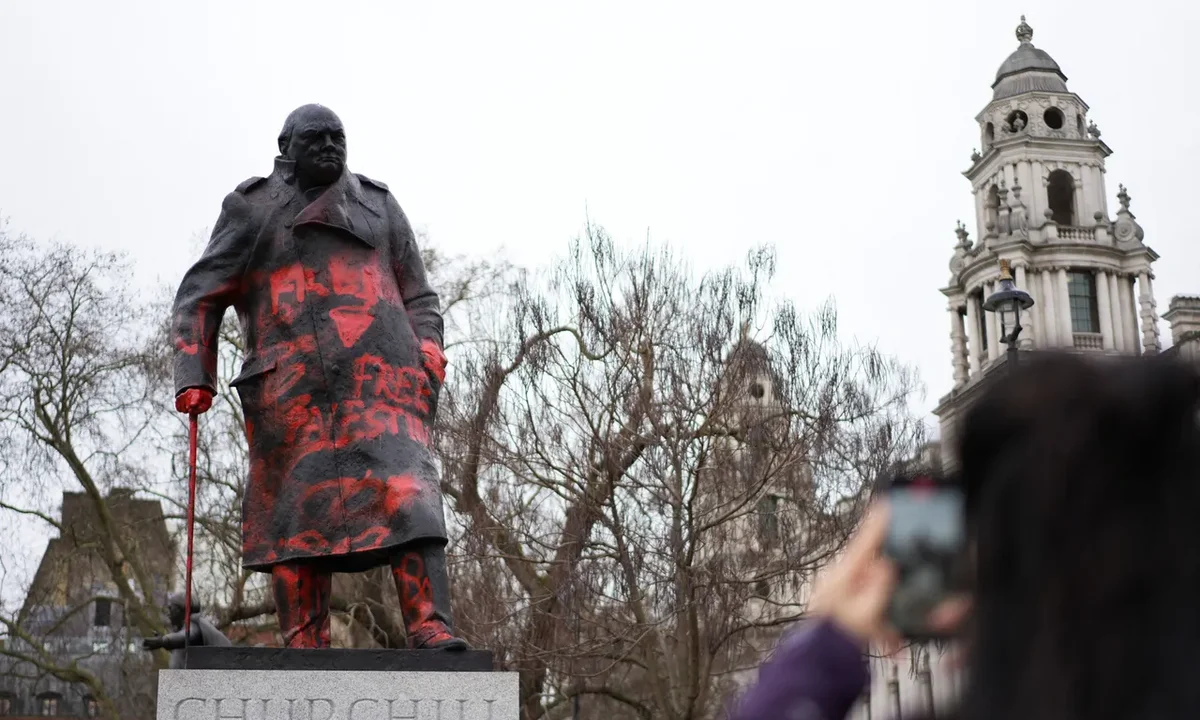
In early 2026, a significant incident occurred in London involving the statue of Winston Churchill, which was defaced with graffiti branding him a “Zionist war criminal.” This event has ignited a multifaceted discussion surrounding themes of historical interpretation, public memory, the ramifications of civil actions, and the relationship between contemporary political movements and historical figures. Such incidents raise essential questions about the ways societies deal with controversial legacies and the mechanisms through which public monuments are engaged, critiqued, or defended.
Historical Significance of Winston Churchill
Winston Churchill remains one of the most emblematic figures in British history, particularly known for his leadership during World War II. His speeches and actions during this tumultuous period garnered him international acclaim and have since positioned him as a symbol of resilience and determination in the face of adversity. However, Churchill’s legacy is not without controversy. His views on empire, race, and governance evoke a spectrum of opinions, reflecting the complex narratives surrounding colonialism and national identity. For further reading on the complexities of colonial legacies, see Understanding the Business Computing World: Key Components, Legal Frameworks, and Career Opportunities.
The Duality of Churchill’s Legacy
Churchill’s legacy exists in a dual realm—admired for his wartime leadership yet criticized for oppressive policies and remarks regarding colonized nations. Key aspects include:
- Wartime Leadership: Churchill’s defiance against Nazi Germany and his oratory skills galvanized public support during critical moments of the war. More on war influences can be found in Understanding Samuel Leeds Finance: A Comprehensive Guide to Bridging Finance for Aspiring Property Investors.
- Colonial Policies: His tenure involved significant decisions that impacted colonies, raising ethical questions about imperialism and the consequences of wartime actions. Explore more on these consequences in Exploring the Versatility of Google Finance Watchlists in the UK.
This complexity necessitates an ongoing dialogue not only about Churchill himself but also about how his legacy is portrayed in public spaces.
The Event and Immediate Reactions
The act of graffiti on Churchill’s statue can be viewed through various lenses—from political protest to vandalism. The immediate reactions from the public and political leaders were polarized, revealing the deeply entrenched divisions within British society regarding historical figures and contemporary political ideologies.
Public Responses to the Incident
Public responses varied widely, highlighting differing views on both Churchill’s legacy and the appropriateness of such a protest. Notable trends included:
- Defenders of Churchill: Many individuals and groups rose to condemn the act of vandalism, viewing it as an affront to history and a misrepresentation of Churchill’s contributions to freedom. Further insights can be found in London & UK Politics – City and National Affairs.
- Critics of Churchill: Conversely, some individuals expressed support for the graffiti, emphasizing Churchill’s controversial stances and questioning the morality of honoring figures with colonial legacies in public spaces. The implications are echoed in Discover Relaxation and Luxury at Ekati Mare Lifestyle Resort in Corfu, Greece.
The responses underscore the tension within public discourse about who deserves to be memorialized and how their narratives are contextualized within modern frameworks.
Comparative Analysis of Monumental Narratives
Situating the Churchill incident within a broader context of other historical figures who have faced similar scrutiny provides insight into trends in how societies reassess their histories. The table below compares different public reactions and their implications.
| Historical Figure | Controversy | Public Reactions | Outcome |
|---|---|---|---|
| Winston Churchill | Colonial policies, wartime leadership | Strong polarization | Public debates on legacy |
| Statue of Robert E. Lee | Civil War implications | Major protests leading to removal | Statue dismantled |
| Cecil Rhodes | Colonialism and racism | Student protests demanding removal | Statue removed |
| Christopher Columbus | Treatment of indigenous peoples | Widespread protests | Several statues vandalized or removed |
The table illustrates that graffiti and vandalism often reflect larger societal discontent with historical narratives. What emerges is a pattern of re-evaluating cultural memory, wherein figures once celebrated may increasingly be portrayed as complex and flawed due to contemporary values and historical context.
In-depth Evaluation of Continued Vandalism and Protest
The instance of graffiti on the Churchill statue symbolizes a broader phenomenon where monuments and public commemorations are sites of dispute. Various sociopolitical factors converge, leading to increased actions challenging traditional narratives.
Significant Social Movements
The Berlin Wall’s fall catalyzed a shift in how societies perceive public memory. Contemporary movements, such as Black Lives Matter and awareness campaigns surrounding colonial history, have spurred critical examination of historical figures and their legacies. Factors include:
- Post-colonial Discourse: Enlightened perspectives regarding colonial history encourage scrutiny of figures such as Churchill. Consider exploring London & UK Tech – Innovation, Startups and Digital Trends for related innovations.
- Globalization of Activism: The interconnectedness of social movements enhances awareness of past grievances and injustices, prompting localized actions like those seen in London.
This section exemplifies that confronting historical narratives often catalyzes societal change, with public protests serving as catalysts for discussions about appropriate historical representations.
Methodological Approaches to Evaluating Historical Narratives
An analytical approach to this topic encompasses qualitative and quantitative methodologies, integrating various data sources, such as public opinion surveys, historical documentation, and media analysis. This evaluation aims to create a holistic view of the public sentiment surrounding controversial historical figures.
Qualitative Analysis
Qualitative methods involve thematic analysis of public discourse, particularly social media reactions and news coverage following the incident. This can help unravel underlying themes and emotions within polarized viewpoints.
Quantitative Analysis
Quantitative aspects could involve measuring public sentiment shifts over time through surveys and polls related to Churchill’s legacy, enabling a data-driven understanding of evolving perspectives. For a deeper look at public sentiment, refer to Understanding the Implications of ‘Monkey Business’ in UK Law: What Businesses Need to Know.
Utilizing a mixed-method approach fosters a balanced, nuanced understanding of public sentiment regarding historical figures and their monuments.
Legal and Regulatory Perspectives on Vandalism
The legal implications of vandalizing public monuments raise important questions regarding free speech, civil disobedience, and historical memory preservation. Laws surrounding public property and the parameters defining vandalism could influence future actions.
Vandalism Laws in the UK
In the UK, vandalism laws can impose significant penalties for defacing public property. The legal framework often raises debates concerning artistic expression versus acts of protest. These tensions reflect a broader societal conflict on how to navigate contrasting views of historical memory.
Implications for Policy Makers
The unrest surrounding Churchill’s statue may lead to changes in how local governments approach monument preservation and context-relative placement. This could include reviewing and possibly reforming existing laws governing public display statutes, leading to more engaging histories that reflect the complexities of national narratives.
Framework for Navigating Historical Controversies
Navigating through the issues surrounding controversial figures and public monuments necessitates a structured decision-making framework. Stakeholders, including policymakers, educators, and community leaders, play vital roles in shaping these narratives.
Framework Components
- Stakeholder Engagement: Understanding community sentiments and historical interpretations through forums and discussions. Consider community aspects illustrated in Exploring Lifestyle Voucher Login and Its Implications.
- Educational Initiatives: Developing curriculum and public programs that contextualize historical figures within contemporary frameworks while encouraging critical thinking.
- Artifact Preservation vs. Interpretation: Considering both the preservation of historical artifacts and potential alterations to public presentations to balance recognition of complex legacies.
Such a framework can facilitate inclusive dialogues that incorporate diverse perspectives while addressing historical grievances, fostering a sense of community and shared understanding.
Evaluating Risks and Potential Trade-Offs
Whenever heritage and public memory are at stake, understanding the potential risks and trade-offs is essential. Incidents like the graffiti on Churchill’s statue present a range of political, social, and psychological implications.
Identifying Risks
- Community Division: Polarizing events risk deepening societal rifts and entrenching positions around historical narratives. See Police Granted Extra Powers Amid ‘School Wars’ Threat in London: Addressing Youth Violence for related discussions.
- Censorship Concerns: Overly punitive measures against acts of protest may inadvertently stifle legitimate discussions regarding historical injustices.
These risks necessitate careful navigation to preserve social cohesion while providing space for diverse perspectives.
Potential Trade-Offs
Facilitating public dialogue around controversial figures comes with inherent trade-offs, such as balancing artistic expression in protests against maintaining societal values associated with heritage.
By examining these elements, a clearer pathway can emerge for reconciling present realities with complicated historical narratives.
Building Trust Through Transparency
The discourse surrounding Churchill’s graffiti encases a larger narrative on trust and transparency in contemporary society. Building trust through unequivocal communication with the public proves vital in contexts where historical representation has splintered opinions.
Methods for Enhancing Public Trust
- Open Dialogues: Creating opportunities for community meetings where history can be questioned and contextualized. Further insights can be gathered from London Events – What to Do in London, Things to See & Experience.
- Educational Outreach: Fostering programs that investigate the dynamics of historical figures, promoting critical engagement rather than passive acceptance.
- Inclusive Policy Development: Involving diverse communities in heritage policy decisions heightens the feeling of ownership and collective memory.
The intertwining of history with modern societal issues subsequently leads to enhanced trust, recognition of varied narratives, and the cultivation of community pride.
Public commemorations are more than historical markers; they embody collective identity, memory, and society’s values. As incidents like the Churchill graffiti evolve, they prompt fundamental questions about the kind of narratives societies wish to uphold or challenge. The continuation of this discourse remains crucial for reconciling differing perceptions of history and confronting legacies, both celebrated and controversial.
The analysis of public reactions and decision frameworks regarding historical figures like Churchill is essential for comprehending contemporary society’s complexities as they relate to memory, identity, and civil action. Balancing respect for heritage with the necessity for critique can guide future efforts in navigating the impassioned landscape of public commemorations and narratives.







Leave a Reply